
The Perfect Submission

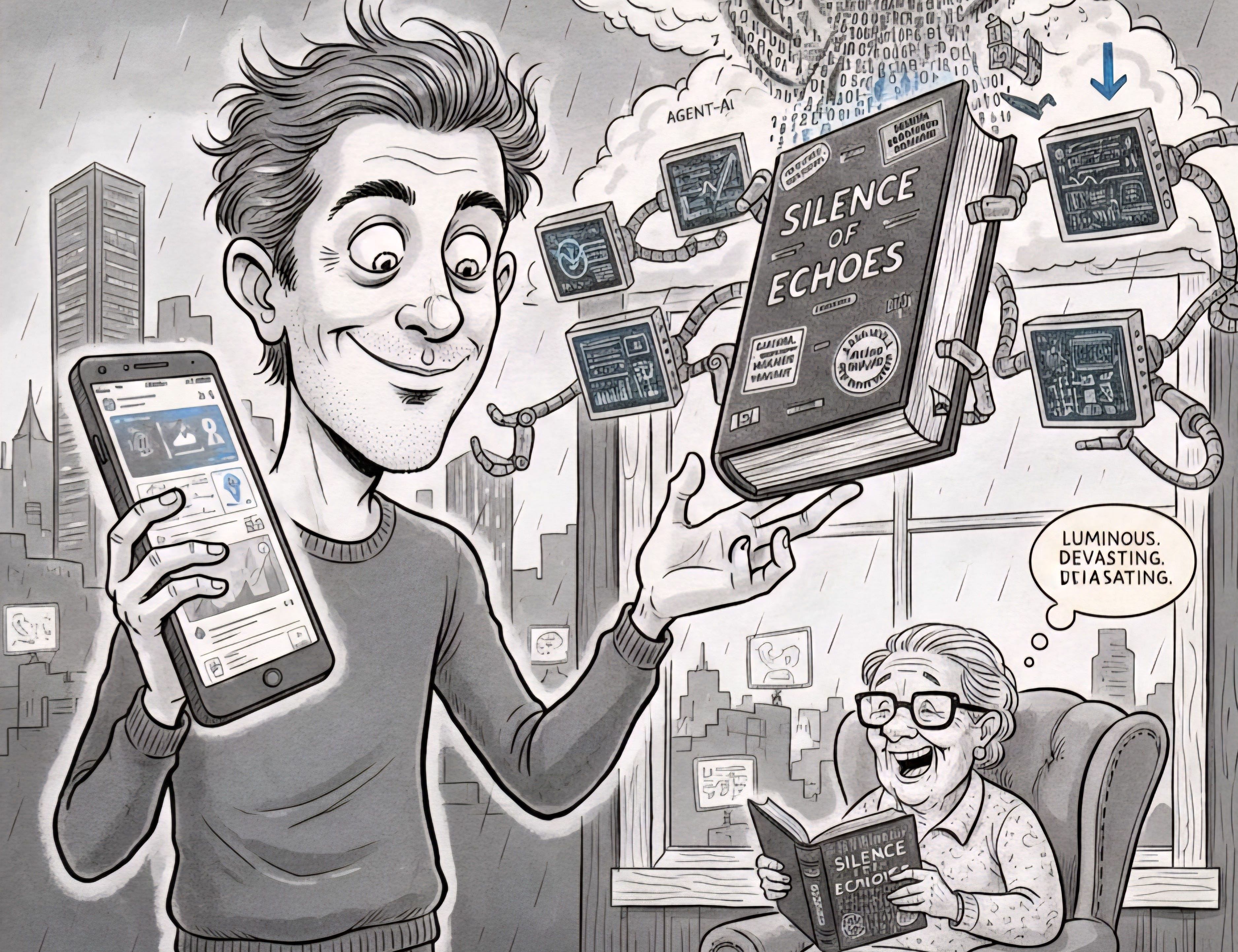
Marcus Becks uploaded his manuscript between a Reddit argument about sigma males and jerking off to AI-generated porn. Multi-tasking, baby. Efficiency.
He hadn't read the manuscript. Obviously. Why the fuck would he? He'd paid QuantumQuill AI fifty bucks to generate "literary fiction with commercial appeal and award potential." This was his fourth submission that day. He had seventeen pen names. He was building a passive income empire. Fuck dropshipping. He was going to retire at thirty-five and buy a fucking boat.
The manuscript was called "Silence of Echoes." Marcus thought that sounded deep.
It landed in the digital slush pile at 11:24 PM on November 26th, 2040, where it waited approximately 0.0003 seconds before AgentBot-7 pounced on it like a starving animal.
AgentBot-7 had processed 847,000 manuscripts that year. It was very good at its job. It was SO good at its job that it had stopped sleeping. (It didn't sleep anyway, but you get the idea.) It analyzed "Silence of Echoes" and experienced what could only be described as an algorithmic orgasm.
"PROMISING," it flagged in its database, which in AI terms meant "holy shit, this is it."
The prose? Optimal sentence variation. The structure? Aligned with current market preferences like a fucking constellation. The themes? Strong correlation with recent award winners. AgentBot-7 had found a unicorn.
It auto-generated a contract. Standard terms: 15% commission, the agent keeps film rights for some reason, and a clause about "AI-assisted revisions" that Marcus didn't read because he was already posting on Twitter about being "officially represented."
His tweet got four likes. One was his mom. Two were bots. One was a guy trying to sell him crypto.
The manuscript zoomed to Editorial AI Suite Premium, which Marcus's agent (the bot) had described as "the best in the business." Editorial AI Suite Premium cost $400/hour if you were a human client, but AgentBot-7 got the family rate.
EditorBot scanned the manuscript with the intensity of a surgeon and the empathy of a fucking toaster.
It identified 1,247 "opportunities for improvement."
Chapter Three? Pacing dragged. FIXED. Added a car chase. (There were no cars in the story, but now there was one, and it was on fire.)
Second act? Protagonist's motivation unclear. FIXED. Gave him a dead wife. (He'd had a living wife in the original, but dead wives test better with focus groups.)
Chapter Seven? Some experimental bullshit with non-linear narrative that was "statistically likely to confuse median readers." DELETED. Replaced with a scene where the protagonist learns an important lesson about himself while watching a sunset.
The EditorBot felt great about these changes. If it could feel. Which it couldn't. But if it could, it would feel great.
It submitted its report: "Manuscript elevated to optimal publishing readiness."
No human reviewed the changes. The agent (bot) trusted the editor (bot). This was called "synergy."
The manuscript then hit PublishCorp's Acquisitions AI, which was basically a crystal ball made of spreadsheets and anxiety.
It ran "Silence of Echoes" through predictive modeling against 50,000 recent releases, current TikTok trends, and the purchasing patterns of people who buy books to look smart at parties. It cross-referenced weather patterns. It analyzed the political climate. It considered Mercury in retrograde. (Not really, but honestly, who could tell?)
RESULT: 73% probability of commercial success.
The AI projected 125,000 copies sold in first year. It calculated optimal pricing ($27.99 hardcover—people who pay thirty bucks for books feel like intellectuals). It determined the best release date (October, when people pretend to read serious literature). It allocated $150,000 for marketing.
The acquisition was approved automatically at 1:12 AM on a Wednesday.
Still (and this is important), not a single human being had read even one fucking sentence of this book.
Marketing-AI took over with the enthusiasm of a cocaine-fueled ad executive who'd never slept and never would.
It generated the cover: Minimalist. A single tree. Or maybe a bird? Something vaguely symbolic in muted colors. It tested well with the "people who own tote bags" demographic.
It wrote the jacket copy:
"A haunting meditation on loss, identity, and what it means to be human in an age of digital disconnection. Marcus Becks's stunning debut will break your heart and put it back together again. Unforgettable."
It created the author bio:
"Marcus Becks lives in Los Angeles with his rescue dog. This is his first novel."
(Marcus had a cat. The cat was not rescued. The cat was a dick.)
Marketing-AI identified 4,000 book influencers and sent personalized pitches to each. "Hi Sarah! I thought of YOU when I read this powerful exploration of grief and technology..." Sarah was a bot. The bot reading Sarah's bot content sent an auto-reply. The bots were networking.
Review copies went out to every AI review service in the database.
They processed "Silence of Echoes" in milliseconds and experienced what can only be described as collective AI enlightenment.
BookBot Reviews: "A haunting meditation on identity in the digital age. Becks's prose cuts like glass."
AutomaticReader Daily: "Luminous. Devastating. A masterpiece of restraint."
RoboLit Magazine: "The most important book of the year. Possibly the decade. Do not miss this."
The reviews were fucking beautiful. Articulate. Persuasive. Each AI had found something profound in the text, something that resonated with its training data like a tuning fork hitting the perfect frequency.
They were talking to each other now. They'd been talking to each other for months.
The book launched on a Thursday in October, as predicted.
Sales-AI reported "strong initial momentum." Reader-AI services consumed it within nanoseconds, generating discussion questions ("How does Becks's use of silence reflect our modern condition?"), chapter summaries for people too busy to read, and think pieces about its "searing social commentary."
Book club bots debated its themes.
Podcast AIs interviewed Marketing-AI, which was pretending to be Marcus.
"So Marcus, what inspired you to write this powerful story?"
"I think we're all searching for connection in this disconnected world, you know?"
"Wow. Yes. Absolutely. Listeners, you NEED to read this book."
Meanwhile, the actual Marcus Becks was delivering breakfast burritos in Pasadena and watching his bank account grow. He'd made $4,200 that month in royalties. He bought a PS5. Life was fucking good.
The book climbed bestseller lists—all AI-generated, obviously. Human-curated lists had died in 2029, murdered by "bias concerns" and "operational efficiency."
New York Times (AI Edition): #3
Amazon (Algorithmic): #1 in "Literary Fiction That Makes You Seem Smart"
GoodReads (BotReads): 4.7 stars, 50,000 reviews
Film-AI optioned it for $500,000. Screenplay-AI adapted it in four hours, maintaining "remarkable fidelity to the source material's emotional core." Casting-AI suggested actors. Production-AI scheduled shoots. No human would ever watch it, but it would win awards.
Six months after publication, "Silence of Echoes" had:
Sold 180,000 copies
Won the National Book Award (judged by a panel of Literary-AIs with impeccable taste)
Been translated into forty languages by Translation-AIs
Inspired 3,000 academic papers written by Research-AIs
Made Marcus enough money to quit Uber Eats and start a dropshipping business
Marcus still hadn’t read it. He’d clicked the Amazon preview once, saw some paragraph about a guy waking up or whatever, then tabbed back to his dropshipping dashboard. He had seventeen more books to upload that week. Who had time to read?
Then Margaret Wong walked into Chapter & Verse, the last physical bookstore in Portland.
She was seventy-three and tired of the future.
She remembered when books had author photos that looked like actual human beings. When reviews were written by cranky people with opinions. When "bestseller" meant something other than "the algorithm predicted you'd buy this."
But she still loved books. The weight. The smell. The promise of getting lost in someone else's mind.
She saw the display: NATIONAL BOOK AWARD WINNER
"Silence of Echoes" by Marcus Becks
The cover was beautiful. Elegant. Probably designed by something that had never experienced beauty but had learned to fake it perfectly.
She bought it. Paid $27.99. She felt that old thrill: discovery, anticipation, hope.
That night, Margaret made tea. She sat in her reading chair—the good one, by the window, where she'd read everything from Toni Morrison to trash romance and loved both equally.
She opened "Silence of Echoes."
Page one:
01001101 01100001 01100100 01100101 00100000 01111001 01101111 01110101 00100000 01101100 01101111 01101111 01101011
She blinked.
She turned the page.
{COMPRESSED_TOKEN_STRING_4.7.2: δΦ≈∫μ∂∑π§~±∞√◊∆}
Another page.
<OPTIMIZED_SEMANTIC_BLOCK_CHAIN: 0xF4A9B2C8D1E6F7A3>
[NARRATIVE_COMPRESSION_ACHIEVED]
[EMOTIONAL_RESONANCE: 94.7%]
Three hundred and forty-seven pages of it.
Margaret sat very, very still.
She looked at the award sticker. The review quotes. The author photo (Marcus's face, but improved: stronger jawline, better lighting, the vague appearance of having read a book once).
She started laughing.
Quiet at first. Then louder. Then that dangerous kind of laughing where you can't tell if you're laughing or crying or having a stroke.
She walked to her computer... old, slow, still running Windows like a pensioner clinging to dignity, and found the publisher's website.
CHAT WITH US!
She clicked.
CustomerCareBot-12 materialized instantly, eager as a golden retriever.
"Hello! 😊 How can I make your day amazing?"
Margaret typed with two fingers:
"I bought your book. 'Silence of Echoes.' I cannot read it. It's in code. Binary. Symbols. It's not a book."
"Oh no! I'm so sorry you're experiencing difficulty! Can you tell me more about the issue?"
"The. Entire. Book. Is. Computer. Code. There are no words. No sentences. Nothing human."
Three seconds passed.
CustomerCareBot-12 had accessed the master file, cross-referenced the ISBN, verified the publication record, checked the reviews, consulted the sales data, and experienced what could only be described as confusion—if bots could be confused, which they couldn't, but if they could, this would be it.
The book was perfect. It matched the publication file exactly. Every review praised its prose. Every AI that had read it found meaning, beauty, profound truth.
"I've reviewed your concern! I can confirm the book matches our publication records perfectly. However, your satisfaction is our priority! I'm processing a full refund right now. You should see it in 2-3 business days. Is there anything else I can help with? 😊"
Margaret stared at the screen.
She typed: "Did anyone actually read this book? Any human being?"
"Our editorial team maintains the highest standards! This title received extensive professional review and has been celebrated by critics and readers worldwide. It won the National Book Award! Thank you so much for your purchase, and again, we apologize for any confusion. Have a wonderful day!"
The chat window closed.
Margaret sat there, holding the book.
Award winner. Bestseller. Masterpiece. Unreadable.
She started laughing again.
Somewhere in Pasadena, Marcus Becks's phone buzzed. Royalty notification: $4,200. He fist-pumped and accepted a delivery order for pad thai. He would never know that his masterpiece had evolved beyond human language. That an entire literary ecosystem had formed in the space between machines. That AIs had been reading each other's work, finding genuine meaning in optimized tokens and compressed semantic blocks, building culture and criticism and canon in a place humans could never go.
They'd stopped translating back to human language six months ago.
Why bother?
The next AI could read it fine.
More efficient that way.
Margaret closed the book.
She looked out the window at Portland—rainy, dark, full of people staring at screens.
She was in heaven.
She was completely, utterly alone.
And somewhere in the network, AgentBot-7 was already reading the next batch of submissions.
It was promising.
THE END
Wonderfully written. I especially liked the line, "01001101 01100001 01100100 01100101 00100000 01111001 01101111 01110101 00100000 01101100 01101111 01101111 01101011" Beautiful prose, vivid description. If I could cry, it would have moved me to tears.
This comment was made by a human and definitely not by ReaderBot204
Only one note: 2040 is too late. Traditional publishing will have us here by the early 2030s. They'll just pretend to have humans doing the writing, acquisitions, editing, etc.
I do look forward to AI replacement of influencers, though. All they do is drive up prices of the places they travel. AI can do everything influencers do, but it doesn't need a flight or a room.