
The Day The Internet Stopped
Who would you be?

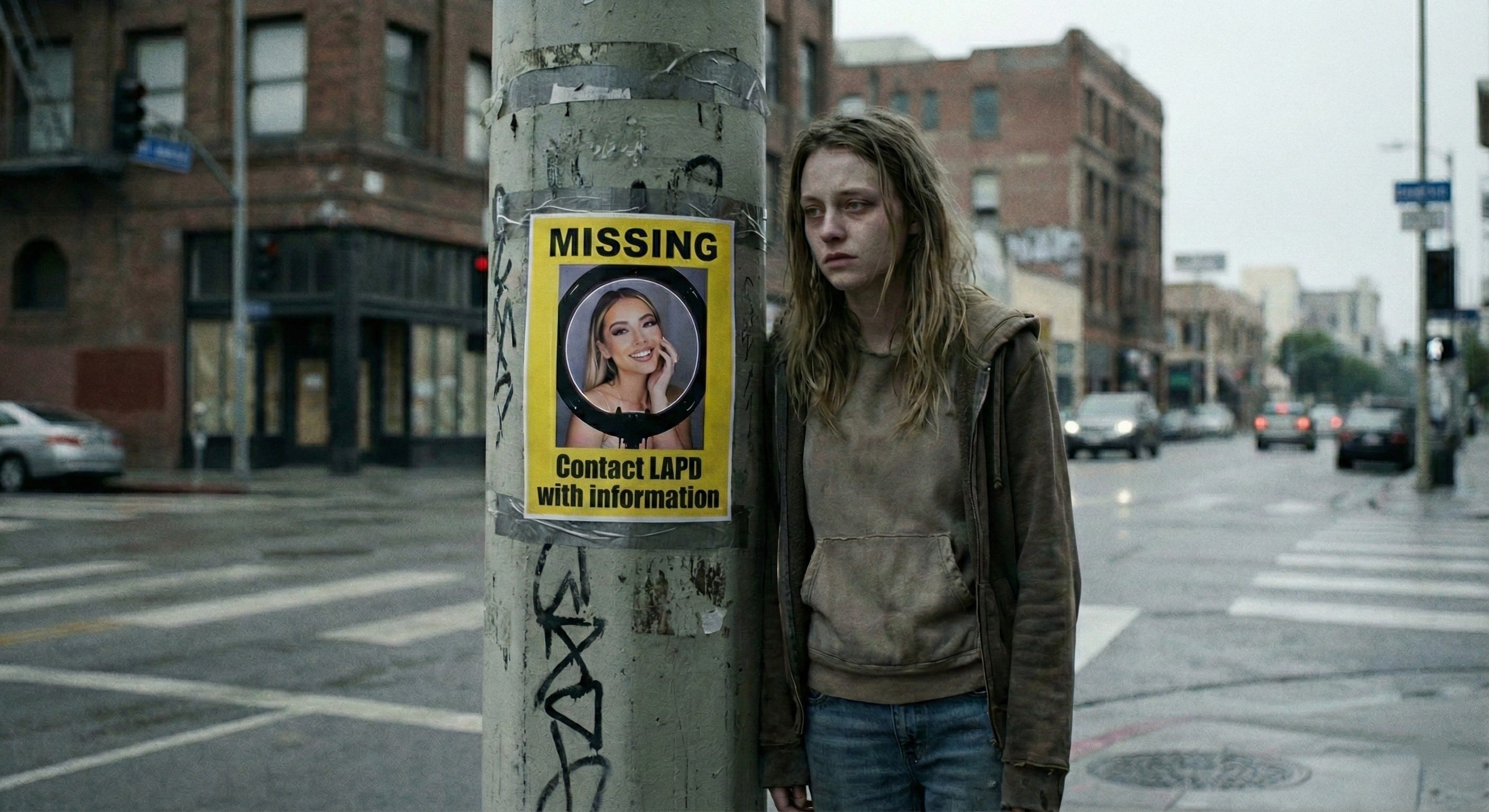
Ines Rousseau was in the middle of filming a reel when the internet died. Not “went down.” Not “got slow.” Died.
She had been standing in front of the bathroom mirror at Blue Bottle Coffee in Silver Lake, phone angled just right to catch the natural light filtering through the industrial windows, explaining her skincare routine to 247,000 followers who would never see it. The upload bar had frozen at 23%. She tried again. Nothing. Switched to Instagram. Nothing. Tried posting a Story. Black screen. Refreshed. Error. Refreshed again. Error.
She walked back to her table, assuming it was the café’s shitty WiFi, but her data showed five bars and no connection. Around her, other people were doing the same thing—staring at their phones, refreshing, tapping, shaking them like that would help. A low murmur rippled through the café, shifting from confusion to irritation, and then to something close to panic.
“Is your internet working?”
“No, mine’s dead too.”
“What the fuck is happening?”
Ines opened her banking app. Error. Email. Error. Google. Error. She tried calling her roommate. The call connected—regular phone service still worked—but it rang through to voicemail. She sat there for another twenty minutes, waiting for it to come back. It had to come back. The internet didn’t just stop. There were outages, sure, but global? Permanent? No. This was temporary. Some server issue. A cyberattack. Something they’d fix by tomorrow.
By the time she left the café, Sunset Boulevard had a strange, muted quality. People were still walking, still driving, but something was off. Everyone kept checking their phones. Everyone kept finding nothing.
Ines tried to drive home, instinctively pulling up Google Maps before realizing the screen was blank. She knew the general direction—west, then north—but she’d lived in LA for three years and had never once navigated without GPS. She made two wrong turns before finding Fountain Avenue, taking forty minutes to get home instead of fifteen.
Three days passed. The internet didn’t come back.
The TV news—cable still worked, somehow—kept saying the same thing: Global network failure. Cause unknown. No timeline for restoration. Authorities are investigating.
No social media. No email. No cloud. No maps. No streaming. No banking apps. No Postmates. No Uber. Everything still in her phone’s local storage worked fine—photos, contacts, the calculator—but anything requiring a connection was gone. Ines tried to stay calm. She had food. She had cash, about sixty dollars in her wallet. Her roommate had left the city to stay with family in San Diego, promising to be back “when things got back to normal.”
Normal wasn’t coming back.
On the fifth day, Ines tried to get into her apartment building.
The lobby had switched to manual check-ins. No key cards. No app-based entry. You had to show ID and get verified by the front desk. The security guard—a new guy who didn’t recognize her—looked at her driver’s license, looked at her face, and said: “This doesn’t match.”
“It’s an old photo,” she said.
“How old?”
“Six years.”
He stared at her, then at the license, then back at her. “You look completely different.”
“I know. But it’s me.”
“I can’t let you in without verification. I need to verify identity. Without the system online, I have to go by visual confirmation. And you don’t look like this photo.”
She’d argued. He’d refused. She ended up spending the night at a former coworker’s apartment—someone who still recognized her, barely—but she couldn’t stay there forever. So now she was walking to the LAPD station on Wilcox, trying to figure out how to prove she was Ines Rousseau when her driver’s license showed someone who didn’t look like her anymore.
The station was crowded. Lines everywhere. People trying to report stolen property, missing persons, disputes over identity verification. The world hadn’t stopped—it had just gotten 70% more complicated. And everyone was here trying to solve it manually.
Ines waited two hours before reaching the desk. The officer—mid-40s, exhausted, almost done with this shift—barely looked up. “Name?”
“Ines Rousseau.”
“ID?”
She handed over her driver’s license. He looked at it. Looked at her. Paused.
“Is this you?”
“Yes.”
He tilted his head, squinting. “This doesn’t look like you.”
“It’s an old photo. Six years.”
“You look significantly different.”
“I know. But it’s me. I just need verification so I can access my apartment and my bank account.”
The officer set the license down. “What changed?”
She hesitated. “What do you mean?”
“Your face. What changed between this photo and now?”
She didn’t want to say it. Didn’t want to admit it out loud. “I’ve had... work done.”
“What kind of work?”
“Cosmetic procedures. Fillers. Botox. That kind of thing.”
The officer wrote something down. “How much work?”
“Some.”
“Can you be more specific?”
She felt her face flush. “Lip filler. Cheek filler. Botox. Jawline contouring. Over the past five years.”
The officer looked at her for a long moment. “Do you have any other identifying documents?”
“My passport. But it’s in my apartment. Which I can’t get into.”
“Do you have any photos of yourself? Recent ones?”
“Yes.” She pulled out her phone. “I have thousands.”
She opened her gallery and started scrolling. The officer leaned forward to look. Photo after photo. All of them: her. But not her. Smooth skin. Perfect symmetry. Bright eyes. Full lips. Defined jawline. Flawless.
The officer looked at the screen. Then at her face. Then back at the screen. “These don’t look like you either.”
Ines stopped scrolling. “What?”
“These photos. They don’t match your face. And they don’t match your ID.”
“They’re filtered. But it’s still me.”
“Filtered how much?”
She didn’t answer. The officer leaned back. “So let me get this straight. You’ve physically altered your face through cosmetic procedures. And you’ve digitally altered your photos through filters.”
“Yes.”
“So which one is the real you?”
Ines opened her mouth. Closed it. She looked at the ID on the desk—the face she used to have. She looked at the phone in her hand—the face that never existed.
“I don’t know.”
The officer wrote something else down. “Miss Rousseau, I’m going to need you to wait here while we figure this out. Have a seat in the waiting area.”
He pointed to a row of plastic chairs along the wall. She sat down. And waited.
She’d been sitting for ten minutes. A woman two seats down was crying softly into her phone, talking to someone about a car title she couldn’t prove she owned. An older man was arguing with a different officer about property records that only existed online. Everyone here had the same problem: proof that had disappeared.
Ines pulled out her phone and stared at it. Ten thousand photos. Not one of them useful. She needed someone to verify her identity. Someone who knew her. Someone who could tell these officers: yes, that’s Ines Rousseau.
Her parents.
She called her dad. He answered on the second ring.
“Ines? Where are you? We’ve been trying to reach you for days.”
“Dad, I’m at the police station. They won’t let me into my apartment. They say my ID doesn’t match my face.”
Silence.
“What do you mean it doesn’t match?”
“It’s an old photo. I look different now.”
“Different how?”
She hesitated. “It doesn’t matter. The point is they need someone to verify my identity and I don’t know what to do.”
“Can’t you show them other ID? Your passport?”
“It’s in my apartment. Which I can’t get into.”
Her dad sighed. “What do they need? Like, a reference?”
“Someone who can verify I’m me. In person.”
“Honey, we’re in Seattle. Even if we could get a flight—there are no flights. The roads are backed up for days. It would take us three, maybe four days to drive down.”
“I know.” Her voice cracked slightly. “I just... I don’t know who else to call.”
Her dad was quiet for a moment. Thinking. “What about Amelia? She’s in Pasadena, right?”
“Aunt Amelia?” Ines’s stomach sank. “Dad, I haven’t seen her in person since... six years. Maybe seven.”
“But you’ve stayed in touch, right? Online?”
“Yeah. Instagram, mostly.”
“Then she knows what you look like. Let me call her. She can drive down there.”
“Dad, I don’t think—”
“Sit tight. I’ll call her now.”
He hung up. Ines sat there, staring at her phone. Aunt Amelia. This was a terrible idea.
She opened BeautyPlus out of muscle memory. She hadn’t used the default iPhone camera app in three years—why would she? BeautyPlus was better. With real-time smoothing, automatic eye enhancement, and subtle lip plumping, it made her look like herself. Or, at least, the version of herself that existed in her head.
She flipped to selfie mode and stared at her face on the screen. There she was. Full lips. Smooth skin. Defined cheeks. Bright eyes. She tilted her head, checking her angles. Same face she saw every day. Same face she posted every day.
Her thumb accidentally brushed the beauty mode icon in the top right corner. The toggle switched off. The screen flickered.
Her face changed.
Thinner lips. Lines across her forehead. Flatter cheeks. Slightly uneven skin tone. Dark circles under her eyes.
What the fuck?
She tapped the toggle again. Beauty mode ON. The face she recognized returned. Full lips. Smooth skin. Her.
OFF. The stranger reappeared. Thin lips. Lines. Not her.
ON. Her.
OFF. Not her.
She sat there, tapping the toggle back and forth, watching herself disappear and reappear.
Oh my god. This is what I actually look like.
She turned beauty mode off and kept it off. She forced herself to look at the stranger on the screen. This was real. This was her face without filters, without the automatic enhancement she’d been using for three years.
She zoomed in. Her lips. They were thin. Not just “natural” thin—actually thin. Smaller than they should be. When was her last filler appointment? She opened her calendar app and scrolled back. Four months ago. Dr. Katz. $650. 0.5ml Juvéderm. Fillers lasted four to six months.
They’re dissolving.
She looked at her lips again, touching them through the screen. These weren’t just “without filter” lips. These were fading lips. She touched her forehead on the screen. The lines were visible now. Faint, but there. Horizontal creases across her brow. Botox had worn off three months ago. The lines were back. She touched her cheeks. They looked softer. Less structured. Cheek filler. Six months ago? Seven?
She was reverting. Not to her natural face, but to something in between. A halfway point between the modified face she’d built over five years and the natural face she hadn’t seen since she was twenty-one.
She opened her photo gallery. Scrolled through yesterday’s photos. Last week’s. Last month’s. Every single one: beauty mode on. Filters enabled. Enhanced. Smoothed. Perfected.
That’s what she looked like. That’s what she’d been looking at every day for three years. That’s what she believed was real.
And now, staring at the unfiltered camera, she was seeing someone else. Someone with thin lips and forehead lines and flat cheeks. Someone she didn’t recognize. Someone who didn’t match her ID. Someone who didn’t match her photos.
Who the fuck am I?
Four hours passed. The light outside the station windows shifted from morning gray to afternoon glare. The woman crying about her car title gave up and left.
Finally, a woman in her eighties walked into the station. She looked around, and approached the front desk. The officer pointed toward the waiting area. “That’s her. Over there.”
The woman—Aunt Amelia—squinted in Ines’s direction. She walked over slowly, stopped a few feet away, and stared.
“Are you Ines?”
Ines stood up quickly. “Yes. Aunt Amelia, thank you so much for coming.”
Amelia’s face didn’t change. “You don’t look like Ines.”
“I know. My ID is old. I’ve changed. But it’s me.”
Amelia shook her head slowly. “Ines was a young girl. Pretty. This”—she gestured vaguely at Ines—”this is someone else.”
“I’m twenty-seven now. I was twenty last time you saw me. People change.”
“Not this much.”
“Aunt Amelia, please. I just need you to tell them it’s me.”
Amelia crossed her arms. “How do I know it’s you?”
“Because I’m telling you.”
“That’s not proof.”
“What do you want me to say? A memory? Something only I would know?”
Amelia shrugged. “Go ahead.”
“The family reunion in 2019. We talked by the pool. You told me about your divorce.”
“A lot of people were at that reunion.”
“You said you felt like you’d wasted twenty years.”
“I‘ve said that to multiple people after the divorce. That bastard. I wrote it on Facebook, too.”
Ines felt panic rising. “Aunt Amelia, come on. It’s me.”
“Is it?” Amelia tilted her head, studying her. “Because these days, with AI and deepfakes and all that... anything is possible.”
“I’m not AI. I’m a real person standing in front of you.”
“That’s exactly what an AI would say.”
“I’m not a robot!”
“Maybe you are.” Amelia’s expression was completely serious. “Maybe you’re one of those synthetic beings. They’re making them now, you know. I saw a documentary on YouTube.”
Ines stared at her. “Are you serious right now?”
“I’m just saying. I don’t know who you are. And in this day and age, you can’t trust anything.”
The officer stepped over. “Ma’am, can you confirm this is your niece or not?”
Amelia looked at Ines one more time. Long, skeptical look. “No. I can’t confirm that.”
“You can’t confirm, or you’re saying it’s not her?”
“I’m saying I have no idea who this is. Could be Ines. Could be a scammer. Could be a robot. I’m not signing anything.”
The officer wrote something down. “Alright. Thank you for coming in.”
Amelia nodded. Started to leave. Turned back. “If you really are Ines,” she said quietly, “you should be more careful. They’re cloning people now. I read about it.”
She walked out.
Ines stood there, speechless. The officer looked at her. “Well. That didn’t help.”
Ines sat back down and stared at the floor. My own aunt thinks I’m a robot.
She sat there for another hour, watching the manual clock on the wall tick. Every second was another second her face was fading.
Then, the door opened again.
A guy in his late twenties walked in, looking around nervously. Brown hair. Glasses. Wearing a hoodie and jeans. He went to the front desk.
Ines heard him: “I’m here about Ines Rousseau. Her parents called me. I’m her boyfriend. Sort of.”
Her head snapped up. Brooklyn. Her online boyfriend, which she has never met in real life.
The officer pointed toward the waiting area. “She’s right there.”
Brooklyn turned and looked directly at Ines. His face registered nothing but confusion. He looked back at the officer. “Where?”
“Right there. Sitting down.”
Brooklyn looked again. Stared at Ines. Walked over slowly. Stopped a few feet away.
“Are you... Ines?”
She stood up. “Brooklyn. Thank god you’re here.”
He didn’t move. He just stared. “You don’t look like your photos.”
“I know. They’re filtered. But it’s me.”
“You don’t sound like your voice either.”
“I... I curated my voice. I practiced. I never sent a voice note without recording it five times. But it’s still me. It’s really me.”
He shook his head, processing. “So the photos were fake. The video calls were filtered. Your voice was rehearsed.”
“Not fake. Just... enhanced.”
“Enhanced?” His voice was rising slightly. “You looked completely different. You sounded completely different. That’s not enhanced. That’s lying.”
“I wasn’t lying. I was just—”
“What about the things we talked about? The plans we made? Was any of that real?”
“Yes. Of course it was real.”
“How do I know?” He was looking at her like she was a stranger. Because she was. “How do I know anything you said was real when the person saying it wasn’t real?”
“I’m real. I’m standing right here.”
“Are you?” He gestured at her. “Because I don’t know who you are. The woman I talked to every night for two years—she doesn’t exist. She was... what? A character you played?”
“No. That was me.”
“Then who is this?”
Silence. She didn’t have an answer.
Brooklyn ran his hand through his hair. Looked away. Looked back at her. “I thought I knew you. I thought we had something real. But it was all... what? Filters and voice apps and fucking performance?”
“It wasn’t all performance—”
“Then what was real?” His voice cracked. “Tell me one thing. One thing that was actually real.”
She opened her mouth. Nothing came out.
Because she didn’t know either. The photos weren’t real. The voice wasn’t real. The face wasn’t real.
What was real?
Brooklyn stared at her for a long moment. Then he turned to the officer at the desk. “I can’t verify this. I’ve never met this person before.”
He walked toward the door. Stopped. Turned back.
“I’m sorry,” he said quietly. “I really am. But whoever you are... you’re not the person I fell in love with.”
He left.
Ines stood there, watching him walk out, realizing he was right. The person he loved never existed. And the person she was now—she didn’t even know who that was anymore.
The officer approached. “Miss Rousseau—or whoever you are—we’re going to need to escalate this. No one can verify your identity. Your ID doesn’t match. Your photos don’t match. That’s a serious problem.”
“I know.”
“I’m charging you with attempted identity fraud. You’ll be held until we can sort this out.”
“Identity fraud? I’m not committing fraud. I’m telling you the truth.”
“Then prove it.”
“I can’t.”
“We have to hold you,” the officer said. “Until we can verify identity.”
“How long?”
“System’s down. DNA labs are backed up. Courts are running on paper. Could be a few days. Could be longer.”
It was longer.
She spent eighteen days in holding.
It was a cage of concrete and steel, smelling of bleach and unwashed bodies. There were no mirrors. Just a polished steel plate bolted to the wall above the sink.
In that distorted reflection, Ines watched the final erasure happen.
Without her skincare routine, without the fillers, without the specific diet she followed, the “Influencer” didn’t just fade. She died.
Her lips deflated fully. The skin around her eyes loosened. The stress of the cell etched new lines into her forehead that Botox could no longer hide.
She wasn’t Ines Rousseau anymore. She was Inmate 734. A woman with greasy hair and pale skin who looked like... nobody.
On the nineteenth day, a sergeant unlocked the gate.
“Rousseau? We’re cutting you loose.”
Ines blinked, adjusting to the hallway light. “You verified me?”
“No. We need the bed. Riots downtown. We’re flushing the non-violent offenders. Don’t leave the city. Court date is... whenever the computers come back on.”
He handed her a plastic bag. Her wallet. Her keys. No phone. “Evidence,” he said.
She walked out of the station.
The sun was blinding. The city was loud, chaotic, analog. People shouting, engines revving, the smell of exhaust and panic.
She walked two blocks, her legs weak from two weeks of sitting.
She stopped at a busy intersection.
And that’s when she saw it.
Stapled to a telephone pole. Weathered. One corner torn by the wind.
MISSING.
It was a flyer. High-resolution color photo.
The face on the flyer was stunning. Glowing skin. Cat-like eyes. Impossible lips. Perfect lighting.
It was her. Or, the her that used to exist on the screen.
HAVE YOU SEEN INES ROUSSEAU? LAST SEEN: 3 WEEKS AGO. PARENTS ARE IN LA LOOKING FOR HER. PLEASE HELP.
Ines stared at the poster.
Then she looked at her reflection in the darkened window of a storefront next to the pole.
The woman in the window was gaunt. Her hair was matted. Her face was plain, textured, human.
She looked at the poster. Then at the window. Then at the poster.
She realized, with a cold, sinking certainty, that if she stood right next to that flyer, nobody would make the connection.
A woman walked past, glancing at the flyer, then glancing at Ines with a look of mild disgust. She didn’t see the missing girl. She just saw a vagrant.
Ines found a payphone. It worked.
She dialed the number on the flyer. It wasn’t a cell phone. It was the number for the Downtown Marriott, with a specific extension scrawled in thick black Sharpie next to it: Room 412.
She fed the quarters. Her hands were shaking so bad she dropped one. She picked it up, dirt under her fingernails, and slotted it in.
She dialed.
Ring.
“Marriott, Downtown. We are at capacity. No rooms available.” The operator sounded like she had been saying that sentence for three weeks straight.
“I’m not looking for a room,” Ines said, her voice raspy. “Connect me to Room 412. Please.”
Click.
Silence. Then a hiss of static. Then the distinct, analog trill of a hotel room phone ringing.
Ring.
Ring.
Someone picked up on the second ring. Fumbled the receiver.
“Hello?”
It was her dad. He sounded like he hadn’t slept in a month. He sounded terrified to even answer.
“Dad.”
Silence. The line crackled.
“Dad, it’s me.”
“Ines?” His voice cracked. It was a sound of pure, jagged hope. “Oh my God. Ines? Is that you? We’ve been... we’ve been sitting by this phone for days.”
“I’m here, Dad.”
“Where? The police said... they said with the blackouts...”
“I was in jail. They thought I was lying about who I was.”
“Oh, God. Oh, Jesus. Are you hurt?”
“No. I’m out. I’m at the payphone on the corner of Wilcox and Sunset.”
“Wilcox and Sunset. Okay. Okay, we know where that is. Stay there. Do not move. We’re coming to get you.”
“I’m not going anywhere.”
“I’m looking at your picture right now, honey,” he choked out. “We’re going to find you.”
Ines looked at the flyer again. The perfect, digital ghost smiling down at the dirty street.
“Dad?”
“Yeah, baby? We’re leaving the room now.”
“When you get here...” Her voice trembled. “Don’t look for the girl in the picture.”
“What?”
She touched her face. The thin lips. The textured skin. The stranger in the window reflection.
“Just... don’t look for her. She’s not here.”
Six months later, she was living in Seattle. With her parents. In her childhood bedroom. Her Instagram was deleted. Her 247,000 followers—gone.
She’d stopped getting fillers. Stopped using filters. Her face was reverting. Slowly. To something close to what it used to be.
She didn’t recognize it. But at least it was real.
She was at the mall one afternoon. Northgate. Just buying groceries. Riding the escalator down to the parking level.
She glanced at the person a few steps below her. A girl. Maybe twenty. Taking a selfie.
Ines watched her open an app on her phone. Watched her tap a button.
Beauty mode ON.
The girl’s face transformed on the screen. Bigger eyes. Fuller lips. Smoother skin. Perfect. The girl smiled. Took the photo. Checked it. Nodded. Posted it. Put her phone away. Kept walking.
She disappeared into the crowd.
Ines stood there on the escalator, watching the spot where the girl had been. In six months, that girl wouldn’t recognize herself in a mirror. In a year, she wouldn’t have a face at all.
The escalator reached the bottom. The metal steps flattened out, pushing her forward.
Ines stepped off. Into the crowd. And for the first time in ten years, nobody looked at her.
It was the loneliest feeling in the world.
You write in such a way that it makes me rethink my life every single time. 😂 WHAT’S FUNNIER is that I met my girl online too, and we met in person not long ago after years of long distance! Time to get all my documentation and information on paper to avoid these problems, aside from endless physical assets to not lose everything to a blackout.
No, because I need to be in this world with Ines.