
Flagged as 97% AI
The algorithm doesn't lie. But it does charge $49.99 a month.

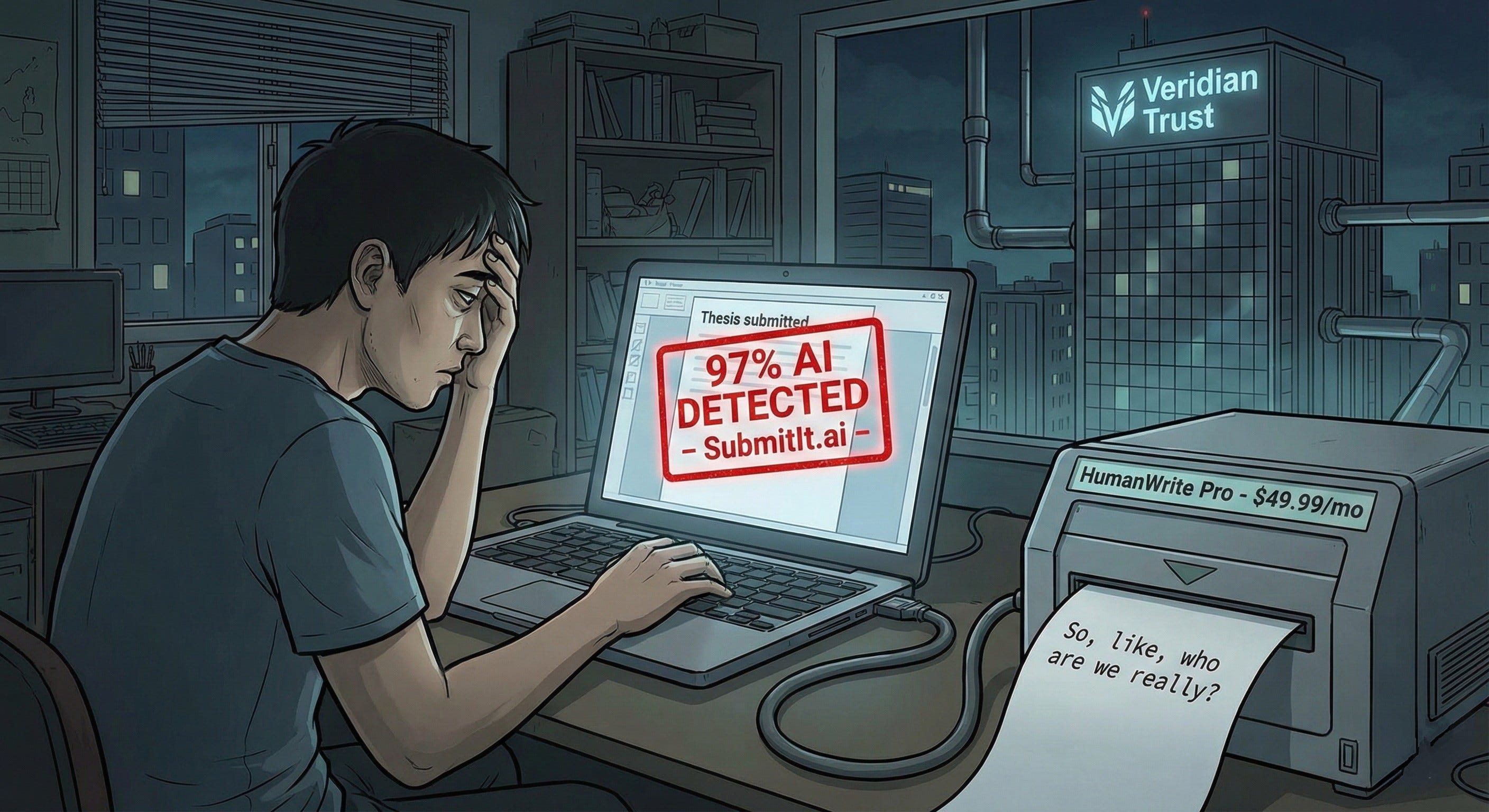
Brandon Choi’s master’s thesis was rejected twice, once because his thesis was identified as AI-generated.
Three years of his life—researching, writing, and rewriting “Authentic Voices: Identity and Narrative Truth in Contemporary Immigrant Literature”—vanished. Brandon examined how second-generation Korean-American writers resolved the conflict between their ethnic background and assimilation. Brandon studied each of the top pieces in the field. He did original interviews. Seventeen rounds of complete revisions were done.
On a Tuesday morning, the email from the Crestview State University MFA committee arrived.
Subject: Thesis Submission Update - Action Required From: Graduate Committee committee@crestview.edu To: Brandon Choi brandon.choi@crestview.edu
Dear Mr. Choi,
Your thesis submission has been flagged by our institutional plagiarism detection system, SubmitIt.ai, with an 89% probability of AI-generated content. As stated in university policy since Fall 2023, all graduate submissions must score less than 20% to be eligible for approval.
We take academic integrity very seriously. Therefore, please arrange a meeting with the committee to discuss your concerns.
Brandon read it three times. He did not use AI. Not even Grammarly. Each word was his own.
The committee meeting was even worse than he had expected.
“Mr. Choi,” Dr. Patterson stated. Her eyes continued to stare at her computer. “The number is pretty obvious. Eighty-nine percent.”
“I wrote each one of these words.” Brandon slammed both hands flat on the table. “If you would allow me to do so, I could provide you with my previous drafts. My original research papers. Timestamps exist for my work.”
“The algorithm does not lie,” Dr. Martinez said. “There are millions of training texts for the large language models that create this algorithm.”
“But I didn’t—” Brandon still tried to present the truth.
“We’re not accusing you of anything yet,” Patterson said. “However, we are providing you with the opportunity to revise and resubmit. To make it more…genuine.”
Brandon went back to his apartment and reread his thesis. Perhaps it sounded too professional, too polished.
Brandon destroyed his own thesis for three days. He made it look like trash. Instead of contractions, he used formal language in some sentences. Some sentences were much longer than others. Awkward personal comments regarding his own identity littered the paper. He removed many of his smoothest transitions and replaced them with brute force. It felt like taking a key to a brand-new car and ruining the paint job. But he wanted to graduate.
He then sent it back to the committee with a note: Re-test. I have rewritten my thesis to avoid any potential issues related to authenticity.
The committee processed it again through SubmitIt.ai.
Result: 93% generated by AI.
Within one day of submitting his revised thesis, he received another rejection email:
Dear Mr. Choi,
We must delve into the concerns surrounding your submission. The tapestry of your argument, while navigating the landscape of contemporary literary discourse, raises questions about the authenticity of your voice. We leverage our expertise to ensure the integrity of our program remains robust...
We regret that your revisions have not alleviated our concerns. Furthermore, the increase in your AI detection score suggests that you may be utilizing increasingly sophisticated AI technologies to circumvent detection.
Your appeal has been denied.
Brandon stared at the email. The words “delve” and “tapestry” leaped out at him.
Brandon copied and pasted the email into SubmitIt.ai.
Result: 97% AI-generated.
He immediately fired off a reply: “An AI generated this rejection email.”
The response arrived within the hour:
Mr. Choi, we are asking the questions here, not you. Please refrain from communicating any additional correspondence on this topic.
Brandon could not fall asleep. At 2 AM, he sat at his desk, researching SubmitIt.ai. There had to be some flaw in it, he thought.
And then he discovered HumanWrite Pro.
Same corporation. Same footer on their website. Even the same location in Delaware.
“Was SubmitIt.ai able to detect your work as AI-generated? HumanWrite Pro can assist! Using superior algorithms that rewrite your text so that it will not fail an AI detection test. Guaranteed results.”
Prices for services provided:
Basic: $19.99/month (10,000 words)
Academic: $49.99/month (50,000 words) — Guaranteed <5% SubmitIt score
Professional: $99.99/month (Unlimited — Enterprise-level humanization)
The company that manufactured the detection software sold the solution to the problem it had created.
Brandon dug deeper.
SubmitIt.ai - founded in 2023 by Veridian Trust Technologies
HumanWrite Pro - founded in 2023 by Veridian Trust Technologies
TextVerify Labs - founded in 2023 by Veridian Trust Technologies
A single corporation owned all three companies—the manufacturer of the detectors and fixers for the AI-detection systems.
Next, he discovered the venture capital firm, Cascade Ventures, which is the primary investor in Veridian Trust Technologies.
Cascade Ventures portfolio:
ClosedAI (the makers of ShitGPT)
Anthropomorphic (the creators of Clod)
Y (the makers of Brok)
The same venture capitalists who backed AI text-generating systems were also backing software to detect AI-generated content. And services that could ‘cure’ it.
It was their business model.
“Well-written thesis you have there! What a shame it would be if someone thought that you wrote it with AI! For $49.99 per month, we can assure you no one will ever think that way again!”
Higher education had always been pay-to-play. Now it was simply more transparent.
Brandon spent one week composing 2,000 words, documenting each point thoroughly, including screenshots of corporate connections and a detailed explanation of the financial incentives.
He named it: “The AI Detection Scam: How a Company Profits from Fake Content by Owning Every Step of the Process to Control the Market.”
Submission to Medium resulted in an immediate rejection: “This submission has been flagged as AI-generated spam content.”
After he revised it and included his own experiences, he contacted the Chronicle of Higher Education to consider publishing an article on the subject.
He received a reply from the journalist: “You have an interesting story, but we cannot publish an article that is flagged as generated by AI, as per our editorial policy. We acknowledge the irony; however, we cannot ignore the policy.”
Brandon attempted to contact the university newspaper. The editor-in-chief was sympathetic. “Dude, I believe you,” he said during a coffee meeting at Starbucks. “But Crestview installed SubmitIt.ai university-wide last fall. I literally can’t run anything that is flagged.”
Brandon verified this via a quick scan of his article through SubmitIt.ai: 94% AI-detected.
“Dude, I’m sorry.”
Brandon decided to utilize Tweetter (now known as Y). Since the mainstream media refused to run his story, he would run it himself.
He composed a 47-tweet thread that illustrated each link. Although he was unable to get much engagement—only 2,400 views and 38 retweets—the thread did go semi-viral.
A community note appeared:
Context added by Brok: This user’s post has been marked as high-probability synthetic media by Brok’s AI assistant, Y. Fun fact: Humans usually produce approximately 3.4 typographical errors per 1,000 words! This thread contained zero typographical errors across 2,847 words.
Engagement ceased entirely after this note appeared. The algorithm had spoken.
Fine. Own platform. Total control.
Brandon created a blog called “Authentic Voices.” He published his entire exposé on the blog and promoted it on LinkedIn, Facebook, and Reddit.
Two weeks later, he reviewed Google Search Console to determine why his blog was indexed but not ranked.
Status: Indexed but not ranking.
Manually searching Google: “AI detection scam” - his exposé was drowning on Page 57. “Veridian Trust Technologies AI detection scam” - Page 71.
Using Veridian Trust’s detection software in its search engine algorithm resulted in low-quality AI-generated content receiving a death sentence in SEO. His extremely well-researched, perfectly written exposé sat algorithmically buried under millions of other web pages.
Clearly defined patterns emerged. Good arguments look like AI-generated arguments. Consistent writing looks like AI-generated writing. Having no typos looks suspicious.
Coherent writing is indistinguishable from AI-generated writing. Bad writing looks like the real deal.
Brandon gazed at HumanWrite Pro’s homepage.
Academic Tier ($49.99/month) - “Guaranteed <5% SubmitIt score.”
He knew it was a scam. The trap. But he needed to get his exposé published. People had to know.
Brandon put in his credit card information and uploaded his exposé.
“Writing authentically human… Processing…”
The progress bar completed slowly. When finished, he viewed the result.
Veridian Trust Technologies has created a business model where it makes money from both creating and managing the market for synthetic media. This arrangement creates a harmful situation in which the company profits by undermining trust in education.
Version after HumanWrite Pro processed it: “So, like, computers are really smart, right? Money is another form of currency that we all use. There is a company doing business here (like when you buy a hot dog from someone and they sell you the bun as well). Maybe the hot dog is fake? Business is complicated… We are viewing this today to assess whether trust is good or bad.”
He stared at his screen for ten minutes. Then he submitted it to Academic Freedom Quarterly—an obscure online magazine that accepted virtually everything.
SubmitIt.ai detected only 4% of Brandon’s exposé as potentially AI-generated. Status: APPROVED FOR PUBLICATION.
It was published three days later. Negative comments poured in:
“Satire?”
“I genuinely cannot understand what you are attempting to convey.”
“Did ShitGPT write this ironically?”
Brandon’s carefully crafted exposé became a meme. The protection racket remained unexposed. The only version that survived was the difficult-to-understand one.
Truth became unpublishable by being well-written.
Brandon Choi had only one alternative remaining.
His thesis—three years of effort and 150 pages of writing about authentic immigrant voices in literature. He uploaded it to HumanWrite Pro Academic for $49.99.
“Processing your document… This may take several minutes…”
Three minutes elapsed until the processed document appeared on the screen.
He did not review it. He knew he couldn’t watch his genuine work gutted.
Brandon saved the processed document and resubmitted it to the committee.
SubmitIt.ai detected only 6% of Brandon’s thesis as possibly generated by AI—status: APPROVED.
Three weeks later, Brandon received an email from the committee:
Dear Mr. Choi,
While your revised thesis meets our criteria for detecting authenticity as acceptable, we cannot approve your thesis based on its current state of literary ineptness. The prose is disjointed; the arguments are incomprehensible, and your thesis’s structural framework has disintegrated.
We recognize there has been considerable deterioration in your overall quality relative to your initial submission, and we must wonder whether you have a sufficient capacity as an author to produce scholarly writing worthy of an MFA degree.
We strongly recommend that you undergo extensive revision before resubmission.
Brandon copied the rejection letter and pasted it into SubmitIt.ai.
Result: 97% AI-generated.
Brandon Choi withdrew from Crestview State University’s MFA program during Spring 2024.
He is currently employed as a content reviewer for SubmitIt.ai, reviewing flagged submissions for $34,000 per annum.
Brandon still has not completed his thesis, nor has anyone read his exposé, which sits unread on page 57.
If “Flagged as 97% AI” made your stomach turn, wait until you meet the guy who deserved the accusation.
Brandon Choi got flagged for something he never did. George Whitman did it—used AI to write his novel and claimed it as his own—and instead of losing everything, he won the country’s biggest literary award for it.
Same technology, different ending.
The Artificial Quill — out August 20th. Pre-order now:
THE END
This story is as haunting as a black mirror episode 😭 It has that same surreal is-this-fiction-or-is-it-the-future feeling. Great work as usual!!
I am a Masters student and my last assessment was flagged as “AI” (it wasn’t). The only way I could save myself was to show previous work of high-quality from pre-AI assessments. They agreed it was my own writing, but now I’m terrified of it happening again.